
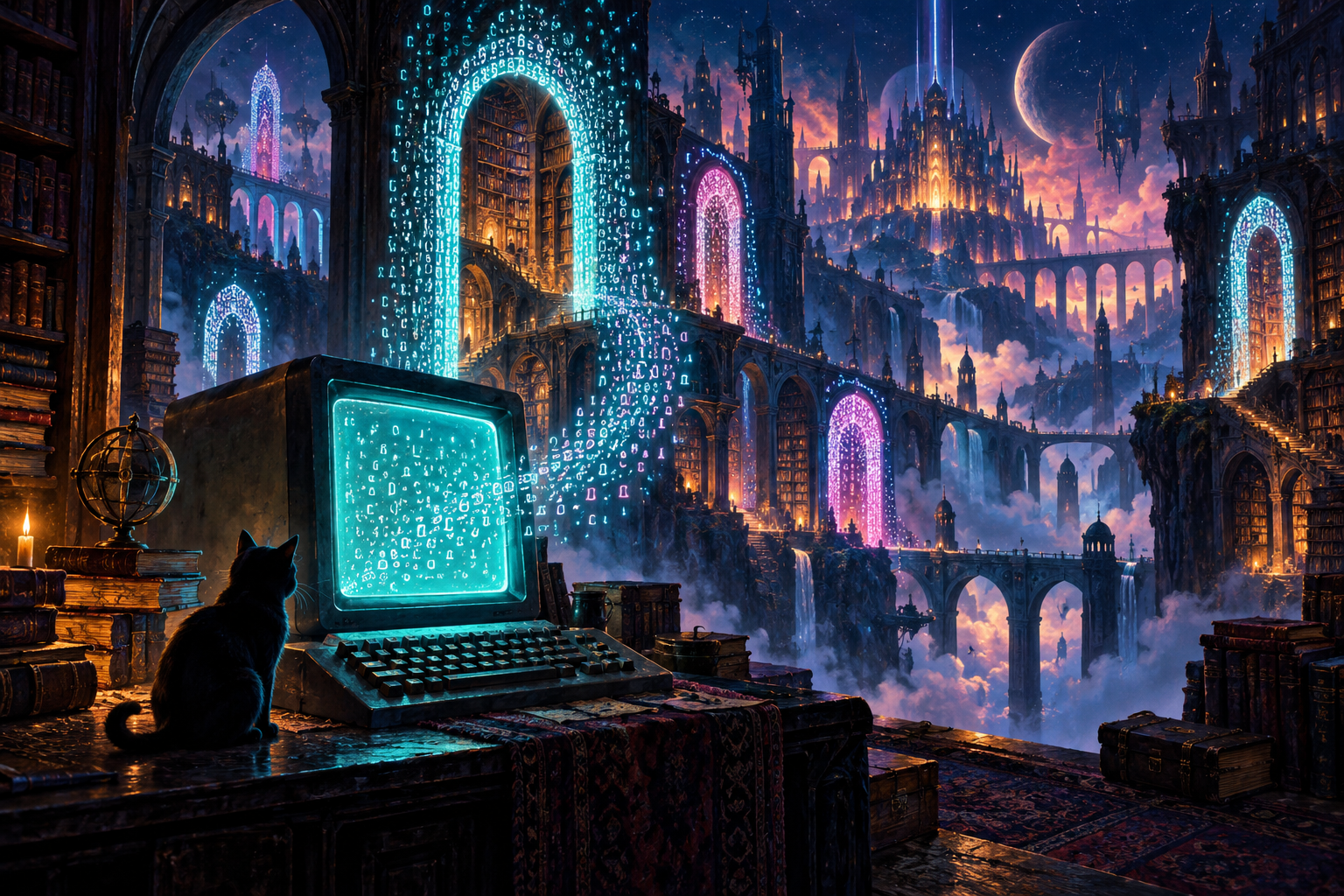
Imagine a room that exists only because someone described it.
There is a brass door, a rain-streaked window, and a stranger who has been waiting longer than they care to admit. Nothing moves until you type. Then a sentence changes, and the room is no longer quite the room you entered.
That is the invitation at the heart of text-based play. The screen offers language; you bring attention, curiosity, and an unreasonable suspicion that the brass door is hiding something.
Welcome to the first InkAndAnsi dispatch. Before we head deeper into individual worlds, here is a field guide to the names you will encounter along the way.
One prompt, several kinds of world
MUDs are shared text worlds. MUSHes often put collaborative roleplay at the center. MOOs make programmable objects part of the world’s structure. Solo text adventures let you explore an authored experience at your own pace.
These are useful starting points, not sealed compartments. Communities borrow ideas, servers evolve, and a label cannot tell you everything about what it feels like to spend an evening there.
MUDs: the room has other people in it
A Multi-User Dungeon connects multiple players to a shared environment. You read descriptions, move between locations, manipulate objects, and interact with other people. Some worlds emphasize combat and progression; others lean toward exploration or social play. Alan Cox’s account, preserved in Richard Bartle’s archive, describes this range and the different ways computers, referees, and players can moderate a world. Read “Multi-User Dungeons.”
The interesting word is shared. A corridor is different when someone else can walk into it. A dangerous expedition can become a negotiation. A familiar meeting place can acquire a reputation that its original room description never mentioned.
Here is an invented scene, not a transcript from a particular game:
> look
The Lantern Room
Rain ticks against the glass roof.
A brass door stands open to the north.
Another traveler is drying a handwritten map.

> say Is that the way out?
The traveler folds the map.
"Depends what you came here to leave behind."
A graphical game could depict that room beautifully. Text leaves the angle of the roof, the traveler’s expression, and the weight of that last line partly in your hands.
MUSHes: play becomes a conversation
In roleplay-oriented MUSH communities, the appeal often lies in writing a character alongside other people. Scenes can develop through descriptions, dialogue, and negotiated outcomes. The wider history of text worlds includes precisely this move toward social interaction and player-moderated storytelling. Cox’s account discusses these approaches.
Think less about finding the perfect attack rotation and more about giving the next writer something interesting to answer. A suspicious glance can be an invitation. An unfinished confession can launch an evening’s story.
That freedom asks something of the participants. Read a community’s rules, learn how it separates player conversation from character dialogue, and ask before imposing a major outcome on somebody else’s character. A compelling entrance leaves room for a reply.
The software is only part of the experience. The other part is the agreement that everyone at the keyboard is helping make the scene possible.
MOOs: what if you could teach the room a new trick?
The object-oriented design of a MOO adds another fascinating possibility. In LambdaMOO, the database represents the world’s objects, while programs called verbs give those objects behavior. Rooms and other objects can inherit behavior from parent objects. Building privileges and permissions govern who can change what. Pavel Curtis’s LambdaMOO Programmer’s Manual explains the machinery in detail.
For a player who likes making things, that suggests a wonderfully slippery boundary between inhabiting a world and designing it.
Imagine a library where a shelf remembers which books you borrowed. Or a door that asks a different question each time it rains. Those are our hypothetical design ideas, not claims about features in a particular MOO. The attraction is the possibility of giving an object a behavior, then letting other people encounter it as part of a place.
You do not need to become a programmer to appreciate the result. But if you have ever looked at a game object and thought, “I wish this did something stranger,” this branch of text-world culture deserves your attention.
Solo adventures: a different conversation with the text
Not every text game needs a room full of players. In a parser adventure, you type an action and discover how the game understands it. The pleasure can be investigative: notice a detail, form a hypothesis, try a command, and reconsider.
Choice-based stories offer a different interface, presenting links or options instead of asking you to supply a command. Both approaches can make reading an active process, but they ask different questions of the player. “What do I want to try?” feels different from “Which of these choices can I live with?”
The tools are worth exploring too. Inform is a language for creating interactive fiction using natural-language syntax. Twine supports interactive, nonlinear stories and can produce a simple story without requiring code. For games, interpreters, and historical material, the Interactive Fiction Archive is a useful place to begin browsing.
A first visit, without the intimidation
You do not have to memorize a family tree of servers before taking a look around. Choose the kind of experience that sounds inviting, then approach it with a little patience.
- Read before rushing. A welcome screen may explain the local commands, rules, and character-creation process.
- Use the game’s own help. Commands such as
lookandhelpare common, but syntax and available actions vary. The example above is illustrative, not a universal command guide. - Start with one small goal. Find a location, examine an object, or understand how to greet someone. Leave mastery for another day.
- Treat the people as people. Ask about local etiquette and respect boundaries around roleplay, conversation, and collaboration.
- Keep a few notes. A name, an exit, or a peculiar phrase may matter later. Making your own map can be part of the pleasure.
If the first world does not click, that does not mean text games are not for you. You may want a different pace, a smaller cast, a sharper puzzle, or more room to build.
Why InkAndAnsi begins here
We are interested in what text makes possible: a city suggested in a paragraph, a character revealed through a choice of verb, a world that becomes more complicated because another person arrived.
This blog is a place to examine those possibilities. We will explore the craft of room descriptions, the cultures of shared worlds, the pleasures and frustrations of parsers, and the experiments that keep language at the center of play.
The cursor is a small thing to build a world around. It is also an open invitation.
Would you like to play a game?